



Plinko Strategy Briefing: Professional Risk and Probability Reference for Canadian Players
Provider:
Hacksaw Gaming / Stake
Game Category:
Instant
Risk Level:
Selectable
Payout Percentage:
95–99%
Smallest Bet:
1
Maximum Stake:
100
Autoplay:
Yes
Launch Date:
01.01.2020
Plinko is a stochastic title with negative expected value. No betting strategy reverses the operator's mathematical edge over a meaningful sample size. This briefing presents a professional treatment of Plinko probability mathematics, risk-level configurations, bankroll discipline frameworks, betting system evaluations, and Provably Fair verification — five domains that determine whether a player navigates the title with informed expectations or operates under misconceptions. The audience is the engaged player seeking factual reference, not the visitor pursuing guaranteed profit. Players are reminded that age requirements apply (19 in most provinces, 18 in Quebec, Manitoba, and Alberta), and ConnexOntario operates 24/7 at 1-866-531-2600 for support inquiries.
Probability Foundations: Binomial Distribution in Plinko
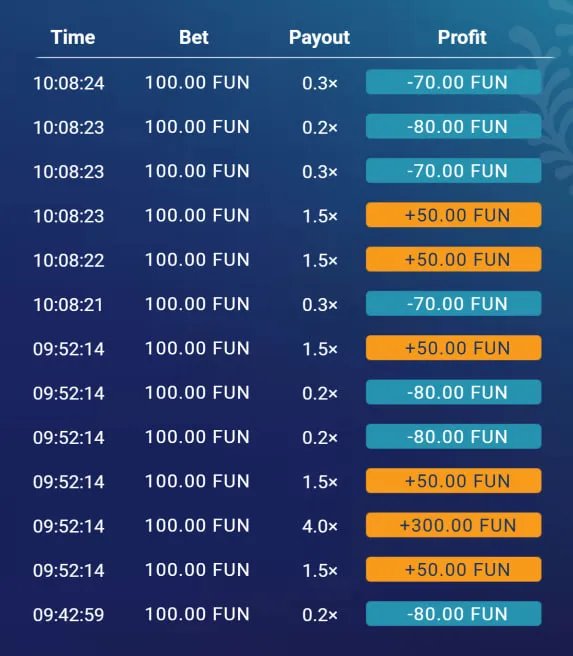
Plinko's outcome distribution arises from a sequence of binary peg interactions. For an N-row board, the ball traverses N pegs, each producing a left-or-right resolution, and lands in one of N plus one slots. The probability of landing in slot k is given by the binomial coefficient: P(slot k) equals C(N, k) divided by 2 to the N-th power. The distribution closely approximates a normal distribution (the Bell Curve), with center slots accumulating the highest probability mass and edge slots collapsing toward zero.
The binomial coefficients are systematically organized in Pascal's Triangle, the recursive structure where each entry equals the sum of the two entries above. Plinko's slot probability distribution corresponds to a row of Pascal's Triangle divided by the total possible paths through the board. For an 8-row board, Pascal's Triangle yields the row 1, 8, 28, 56, 70, 56, 28, 8, 1 — summing to 256 (= 2^8). Slot 4 (center) accumulates 70/256 = 27.3 percent of outcomes; the edge slots collect 1/256 = 0.39 percent each. The convergence of the binomial distribution to the normal distribution as N increases is a foundational result of probability theory, and Plinko's bell curve is a direct visualization of it.
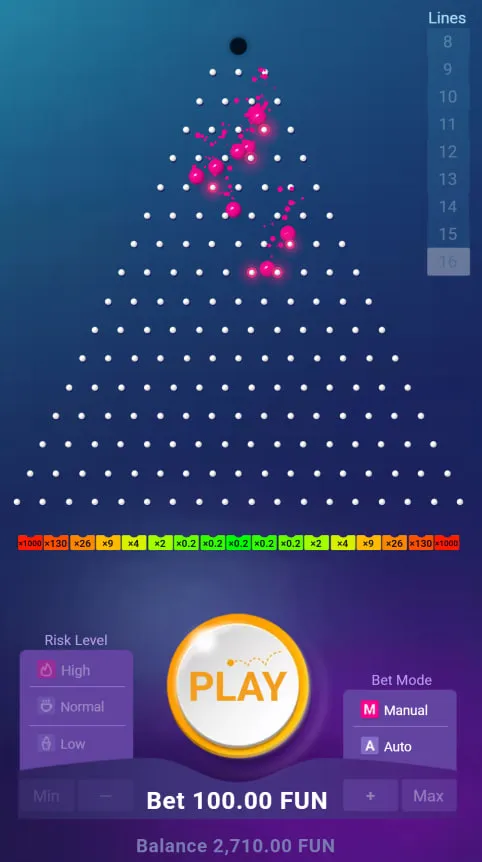
For a 16-row board — the standard configuration at BGaming, Hacksaw Gaming, and Stake Originals — the calculations resolve as follows. Slot 0 (leftmost edge): C(16, 0) divided by 65,536, equal to 1 in 65,536, or 0.0015 percent. Slot 8 (center): C(16, 8) divided by 65,536, equal to 12,870 in 65,536, or 19.6 percent. Edge multipliers (frequently advertised at 1,000 times the bet and above) carry probabilities of negligible significance for the typical session.
Expected value follows the classical formula: EV equals the sum of probability multiplied by multiplier across all slots. For BGaming and Stake Originals, EV equals 0.99 of the bet — the published 99 percent RTP. Hacksaw Gaming's calculation resolves to 0.9898; Spribe's resolves to 0.97.
| Slot | Probability (16 rows) | BGaming Medium-Risk Multiplier |
| 0 / 16 (edge) | 0.0015% | 110× |
| 2 / 14 | 0.18% | 14× |
| 5 / 11 | 6.7% | 2× |
| 7 / 9 | 17.5% | 1.0× |
| 8 (center) | 19.6% | 0.5× |
Risk Levels: Variance and Volatility Configuration Without RTP Adjustment
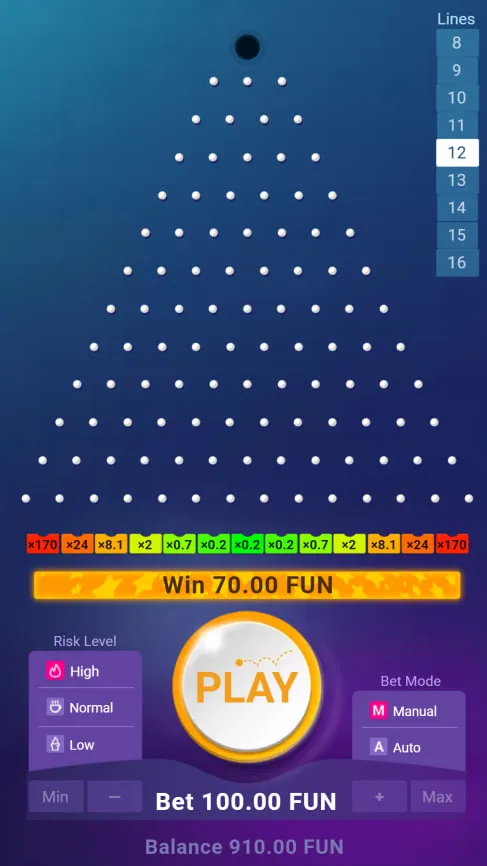
BGaming, Hacksaw Gaming, and Stake Originals each provide three risk configurations: Low, Medium, and High. RTP does not change across risk levels. This is a structural property of the design and warrants emphasis, as misconception is widespread. What changes is the variance and volatility profile. Low risk compresses the multiplier range, producing low-volatility equity curves with smooth oscillation. High risk extends both ends of the range — center multipliers fall as low as 0.2 times the bet, while edge multipliers reach 1,000 times at BGaming and 3,843 times at Hacksaw Gaming — producing a high-volatility profile with rare but significant payouts.
Volatility, in formal probability terms, refers to the standard deviation of returns per spin. Plinko's high-volatility configuration carries standard deviation roughly 5 to 8 times that of the low-volatility configuration at equivalent bet sizes. Variance is the squared standard deviation; both measures characterize the dispersion of outcomes around the expected value but do not alter the expected value itself.
The bankroll consequence is significant. Maintaining equivalent expected playtime at high risk requires three to five times the bankroll allocated to low risk, primarily because high-risk center multipliers reduce per-spin returns below the bet. A player operating at high risk with insufficient capitalization faces accelerated risk of ruin even at identical RTP.
Risk Calibration by Player Profile
Recreational players are advised to operate at low or medium risk with row counts of 8 to 12. Variance-tolerant players with sufficient bankroll capacity may select high risk with 16 rows, accepting extended losing streaks in exchange for the possibility of rare, large multiplier strikes.
Row Count and Plinko Rows: Selection Framework

Operators commonly support 8, 12, 14, and 16 row configurations — referenced collectively as Plinko Rows. Increasing Plinko Rows widens the multiplier range and sharpens the bell curve. Center slot probability decreases from 27.3 percent on 8 rows to 19.6 percent on 16 rows; edge probabilities collapse from 0.39 percent to 0.0015 percent.
| Rows | Outcomes | Center Probability | Edge Probability | Suitable For |
| 8 | 9 | 27.3% | 0.39% | Casual, low variance |
| 12 | 13 | 22.6% | 0.024% | Balanced |
| 16 | 17 | 19.6% | 0.0015% | Variance hunting |
Bankroll Management: A Quantitative Discipline
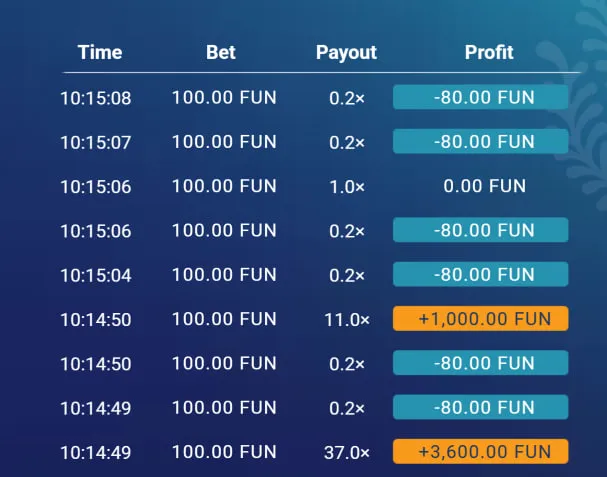
Bankroll discipline is the only player-controlled variable that materially affects Plinko outcomes. Recommended bet sizing falls within 0.5 to 2 percent of bankroll per spin at low risk, and 0.1 to 0.5 percent at high risk. Expected spins available is approximated by the formula: Spins equal Bankroll divided by Bet, multiplied by RTP divided by 1 minus RTP. For a C$200 bankroll with a C$1 bet at 99 percent RTP, the expected count is approximately 19,800 spins before depletion — though variance produces substantial deviation around this expectation.
Stop-loss and stop-win thresholds frame each session. The recommended stop-loss is 30 to 50 percent of session bankroll. The recommended win goal is 50 to 100 percent. Session duration of 30 to 60 minutes is recommended. Concrete examples follow.
| Bankroll | Risk | Recommended Bet | Expected Spins | Stop-Loss | Win Goal |
| C$100 | Low | C$0.50 | ~9,900 | C$30 | C$50 |
| C$500 | Medium | C$2.50 | ~9,900 | C$200 | C$300 |
| C$1,000 | High | C$2.00 | ~24,500 | C$400 | C$700 |
A clarification consistent with editorial integrity: no bankroll strategy renders Plinko profitable in expectation. These methods extend playtime and reduce risk of ruin within a session. They do not generate profit. Claims to the contrary mislead.
Common Betting Systems: Structured Evaluation
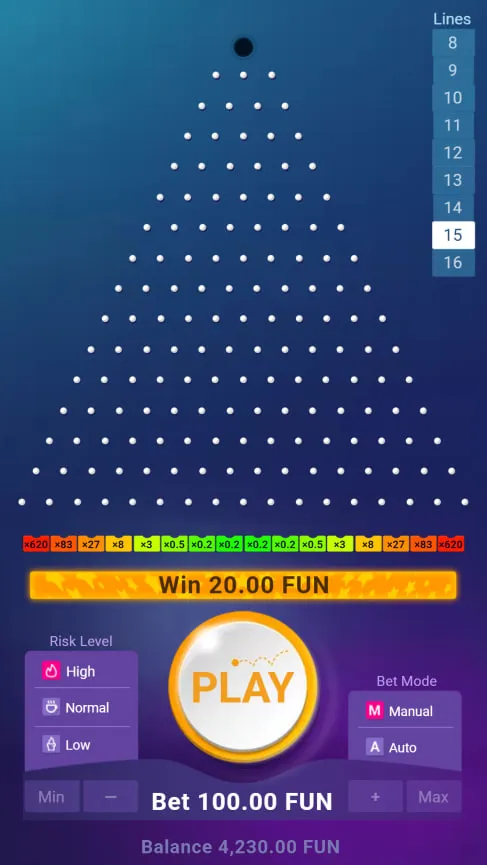
Martingale System
Martingale doubles the bet after each loss, intending to recover all accumulated losses with a single subsequent win. The system fails for two structural reasons: operators impose maximum bet limits, and finite bankroll caps the doubling sequence. A C$1 base bet doubled across eight consecutive losses requires C$256 on the ninth round, with C$255 already lost. On high-risk Plinko, eight consecutive sub-1× outcomes occur frequently enough to bankrupt typical bankrolls.
Fibonacci Progression
The Fibonacci sequence (1, 1, 2, 3, 5, 8, 13...) produces slower bet escalation than Martingale, extending bankroll survival but introducing identical structural failure on extended losing streaks. Expected value remains negative.
Flat Betting
Flat betting maintains constant bet size across all rounds. Mathematically, this approach minimizes risk of ruin per unit time and produces the smoothest equity curve. The recommended default for the majority of recreational players.
Reverse Martingale (Anti-Martingale)
The system doubles after wins rather than losses, locking in profits during streaks. Maximum loss is the initial bet; downside is bounded. Variance is contained but expected value remains negative.
Paroli Progression
Paroli is a three-step win progression: bet escalates after the first and second consecutive wins, then resets. Structured upside with limited downside. Suitable for variance-positive sessions but does not modify long-run RTP.
The general principle: betting systems redistribute when wins and losses occur. They do not change the underlying expected value. Flat betting remains the most defensible default for recreational play.
Identification of Plinko Scams
Several scam categories operate around Plinko and warrant flagging. Predictor applications and Telegram bots claim to forecast the next ball outcome; this claim is mathematically incompatible with Provably Fair cryptography. Paid VIP strategy courses promise insider knowledge — there is no insider knowledge in a system whose RNG is independently audited by eCOGRA and iTech Labs. Hacked-RTP claims are similarly false; published RTP values are integral to certified game logic.
Red flags warrant attention. Payment required to access a "secret" strategy, testimonials with no independent audit, claims of 100 percent or guaranteed wins, "limited-time" pressure tactics, and operators not listed on regulator whitelists each indicate scam activity. Provably Fair verification — covered in the next section — is the legitimate cryptographic alternative.
Players encountering scam activity may report to the AGCO complaint form (Ontario) or the Canadian Anti-Fraud Centre at 1-888-495-8501.
RTP Optimization Through Plinko Variations Selection

Within a given Plinko title, settings (risk and rows) do not change RTP. Across titles and Plinko Variations, RTP varies meaningfully. Stake Originals and BGaming publish 99 percent. Hacksaw Gaming publishes 98.98 percent. Spribe operates at 97 percent. Hybrid Plinko Variations — Plinko Hilo, Plinko ladder variant, mines-Plinko fusion — frequently publish lower RTPs in the 96 to 98 percent range. Players seeking maximum theoretical return should select classic 8-row to 16-row Plinko at BGaming or Stake Originals.
Each major Plinko Variations category presents distinct expected-value characteristics. Plinko Hilo combines drop mechanics with high-low card prediction, raising house edge through the dual-decision structure. Plinko ladder variants apply a vertical multiplier escalation grid — engaging gameplay but typically lower published RTP. Mines-Plinko fusion titles overlay mine-detection hazards on the Plinko board; max wins increase but probability of total bankroll loss within a single round is also elevated. Verification of RTP via the in-game info panel before depositing on hybrid Plinko Variations is recommended.
Provably Fair: Verification Protocol
Provably Fair is a cryptographic protocol that allows players to verify game outcomes were not manipulated post-spin. The protocol implements a five-step process.
- The casino generates a server seed and publishes its SHA-256 hash before the spin.
- The player provides a client seed (random or custom).
- The spin executes; the server seed is revealed.
- The player computes the SHA-256 hash of the revealed server seed and compares it to the originally published hash. The values must match.
- The player runs the combined seed through the documented game algorithm and confirms the output matches the observed outcome.
BGaming, Stake Originals, and Hacksaw Gaming each implement Provably Fair. Verification panels are typically built into the operator's interface, eliminating the need for external tools. Independent verifiers are publicly available for players preferring third-party computation.
Setting Limits and Knowing When to Stop
The most consequential strategic decision a Plinko player makes is setting deposit limits, loss limits, and time limits at signup. Deposit limits cap funds transferred into the account per day, week, or month. Loss limits — a structurally distinct control — cap net session losses, interrupting play even when the deposit ceiling has not been reached. Time limits restrict total active session duration. Reality check intervals (alerts every 30 or 60 minutes) interrupt extended sessions. Self-exclusion protocols range from 24-hour cooling-off periods to permanent account closure. Ontario operators participate in the GameSense framework. ConnexOntario operates 24/7 at 1-866-531-2600. The Responsible Gambling Council (RGC) is reachable at 416-499-9800; the RGC operates the Canadian standard for problem-gambling resources and coordinates GameSense with provincial operators. CAMH offers support at 416-535-8501.
Frequently Asked Questions
Does a guaranteed Plinko strategy exist?
No. Plinko has a built-in house edge of 1 to 3 percent. No betting strategy overcomes negative expected value over the long run. Anyone selling guaranteed wins is operating a scam.
Which risk level is recommended — what's the best risk level in Plinko?
The recommendation depends on bankroll capacity and tolerance for variance. The best risk level for preserving bankroll is Low; the best risk level for chasing rare large multipliers is High; Medium balances both. RTP is identical across all three configurations, so the question of best risk reduces to a question of preferred volatility profile and bankroll capacity.
Does the Martingale system work on Plinko?
No. Martingale fails because compound losses combined with table bet limits produce realistic bust scenarios within seven to nine consecutive losses. On high-risk Plinko, those streaks occur frequently.
How is Plinko fairness verified?
Through Provably Fair cryptography. The casino pre-commits a SHA-256 hash of the server seed; after the spin, the player reveals the seed and verifies the hash matches the original commitment. The combined seed is then run through the game algorithm to confirm the outcome. Most operators provide a built-in verifier.